
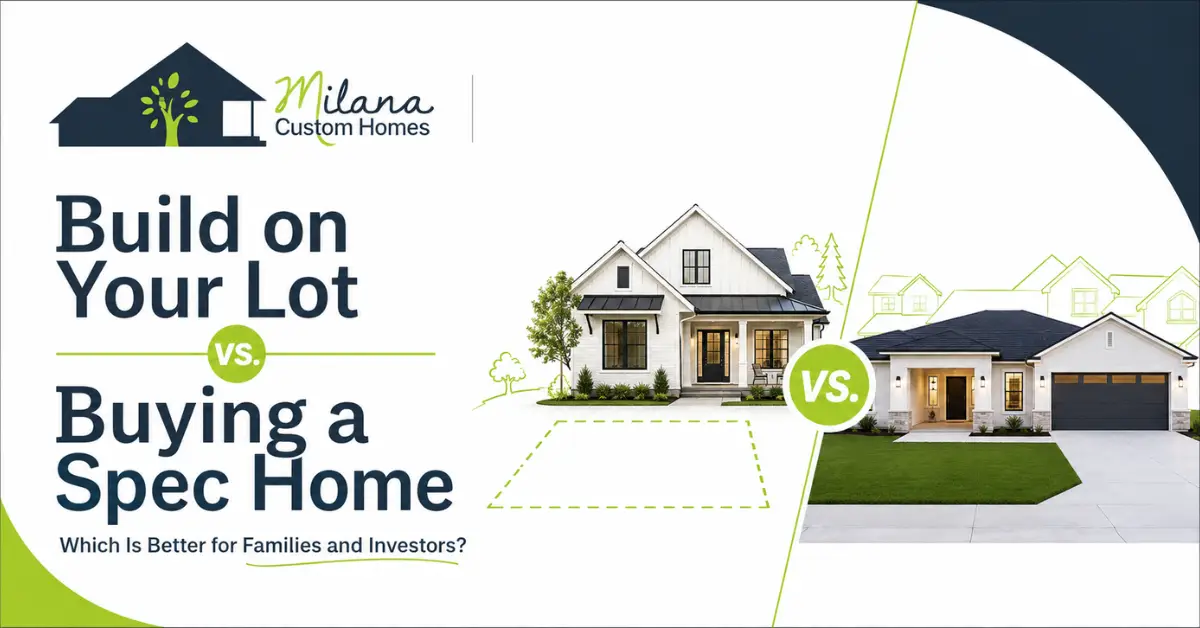
Build on Your Lot vs. Buying a Spec Home: Which Is Better for Families and Investors?
When planning a new home, one of the biggest decisions is whether to build on your lot or buy a spec home that is already built or nearly complete. Both options can be smart, depending on your goals, timeline, budget, location, and how much control you want over the final design.
For families, the decision often comes down to lifestyle, school districts, space, layout, and long-term comfort. For real estate investors, the choice may depend more on acquisition cost, resale value, rental demand, construction timeline, and market risk.
So, is it better to build on your own lot or buy a spec home? The answer depends on what matters most to you. A trusted custom home builder can help you compare both options clearly so you can make a confident decision before investing in land, plans, or a completed home.
What Does It Mean to Build on Your Lot?
To build on your lot means you already own a piece of land, or you plan to purchase land, and then hire a builder to design and construct a home on that property. This option gives you more control over the location, layout, architectural style, finishes, and long-term functionality of the home.
Building on your lot is especially appealing if you have a specific neighborhood in mind, want more privacy, need a larger property, or want a home tailored to your family’s lifestyle. It can also be attractive for investors who want to develop land, create a custom rental property, or build in a market where new homes are in high demand.
However, building on your lot also requires more planning. Before construction begins, the lot must be evaluated for zoning, utilities, soil conditions, drainage, setbacks, access, permitting, and site preparation needs.
What Is a Spec Home?
A spec home, short for speculative home, is a new home built by a builder before a specific buyer has committed to purchasing it. The builder chooses the floor plan, finishes, layout, and features based on what they believe will appeal to the local market.
Spec homes are popular because they are often move-in ready or close to completion. This makes them a convenient choice for families who need to relocate quickly or investors who want a faster path to occupancy, rental income, or resale.
The tradeoff is that buyers usually have limited control over the design. Depending on the stage of construction, you may be able to choose a few finishes, but the major layout, structure, and design decisions are usually already made.
Build on Your Lot vs. Spec Home: Main Differences
The biggest difference between building on your lot and buying a spec home is control versus convenience.
When you build on your lot, you have more control over the home’s design, location, features, and long-term value strategy. When you buy a spec home, you usually get speed, simplicity, and a more predictable purchase process.
Here is a simple comparison:
- Design Control
Build on Your Lot: High control over layout, finishes, and features
Buying a Spec Home: Limited control, especially if home is complete - Timeline
Build on Your Lot: Longer planning and construction timeline
Buying a Spec Home: Faster move-in or investment timeline - Location Choice
Build on Your Lot: Flexible if you own or find the right lot
Buying a Spec Home: Limited to available spec homes - Cost Predictability
Build on Your Lot: Depends on land, site work, design, and selections
Buying a Spec Home: Usually clearer upfront pricing - Customization
Build on Your Lot: Highly customizable
Buying a Spec Home: Minimal to moderate customization - Family Fit
Build on Your Lot: Strong fit for specific lifestyle needs
Buying a Spec Home: Best if existing layout works well - Investor Fit
Build on Your Lot: Good for targeted development or premium resale
Buying a Spec Home: Good for quicker resale or rental use - Risk Factors
Build on Your Lot: Site conditions, permits, construction variables
Buying a Spec Home: Market pricing, limited differentiation
Cost Breakdown: Build on Your Lot vs. Buying a Spec Home
Cost is one of the most important factors in this decision. While a spec home may feel simpler because it has a listed price, building on your lot involves several cost categories that should be reviewed before making a decision.
- Land Cost
Build on Your Lot: Required if you do not already own land
Spec Home: Usually included in purchase price - Site Preparation
Build on Your Lot: Clearing, grading, utilities, drainage, soil work
Spec Home: Already completed by builder - Design and Engineering
Build on Your Lot: Custom plans, surveys, engineering, permits
Spec Home: Included in builder’s development cost - Construction Cost
Build on Your Lot: Based on size, materials, labor, and complexity
Spec Home: Built into sales price - Finish Selections
Build on Your Lot: Flexible, from standard to luxury
Spec Home: Pre-selected or limited options - Carrying Costs
Build on Your Lot: May include loan interest, taxes, insurance during build
Spec Home: Usually shorter carrying period - Contingency Budget
Build on Your Lot: Recommended for unknown site or construction issues
Spec Home: Less commonly needed by buyer - Long-Term Value
Build on Your Lot: Can be optimized for lifestyle or resale strategy
Spec Home: Depends on market demand and builder choices
For families, the most important cost question is not just “Which is cheaper?” but “Which option gives us the best long-term value for how we live?”
For investors, the key question is whether the added control of building on a lot will create enough additional value to justify the longer timeline and development risk.
When Building on Your Lot May Be the Better Choice
Choosing to build on your lot may be the better option if you want a home designed specifically around your needs. Families often choose this route when they want a specific school district, more outdoor space, a multigenerational layout, a dedicated office, a larger garage, or custom indoor-outdoor living areas.
It may also be better if you already own land. In that case, working with a custom home builder can help you determine what can realistically be built on the property and what site improvements may be needed.
For investors, building on your lot can be a strong choice when the land is in a desirable area, the finished home can command a premium, or the project fills a gap in the local market. A well-designed custom or semi-custom home can stand out from standard inventory, especially in areas where buyers are looking for new construction with better finishes and thoughtful layouts.
However, this option works best when you have a realistic budget, a flexible timeline, and a builder who can guide you through due diligence before construction begins.
When Buying a Spec Home May Be the Better Choice
Buying a spec home may be better if speed and simplicity are your top priorities. For families relocating for work, moving before the school year, or needing a predictable closing date, a spec home can be the more practical option.
Spec homes can also make sense for buyers who like the layout and finishes already selected by the builder. If the home is well-built, in a strong location, and priced fairly, it may offer a smoother path than starting from raw land.
For investors, a spec home can be attractive because it may allow for quicker rental placement, resale, or occupancy. There is less uncertainty around permitting, construction schedules, and site conditions because most of those issues have already been handled by the builder.
The downside is that spec homes may not offer the same level of uniqueness or strategic customization. If several similar homes are available in the same area, resale differentiation may be limited.
Local Factors to Consider Before Deciding
Real estate is highly local. Before deciding whether to build on your lot or buy a spec home, consider the market conditions in your area.
In some neighborhoods, available land is limited, making spec homes more common. In other areas, larger lots, teardown opportunities, or infill properties may make custom building more attractive. Local permitting timelines, utility access, homeowner association rules, flood zones, soil conditions, and design guidelines can also affect cost and feasibility.
This is why working with a local custom home builder matters. A builder familiar with your area can help you evaluate whether a lot is buildable, what hidden costs may exist, and whether a spec home’s price reflects its true value.
Which Option Is Better for Families?
For families, building on your lot is often better when lifestyle customization matters most. If you want the home to fit your routines, storage needs, work-from-home setup, children’s spaces, entertaining style, and future plans, a custom build gives you more flexibility.
A spec home may be better if you need a faster move, prefer a simpler buying process, or find a home that already checks most of your boxes. The right choice depends on your timeline, budget, and how specific your needs are.
Which Option Is Better for Investors?
For investors, building on your lot may offer stronger upside if the project is well-planned, the land is purchased wisely, and the finished home meets clear market demand. It allows you to control product type, finishes, square footage, and positioning.
A spec home may be better for investors who want faster turnaround, less construction risk, and a more predictable acquisition. It can be a practical option for rental portfolios, short-term resale strategies, or markets where completed new construction is in demand.
The best investment choice should be based on numbers, not assumptions. Compare acquisition cost, build cost, holding cost, projected resale or rental income, and local buyer demand before deciding.
FAQ: Build on Your Lot vs. Buying a Spec Home
Is it better to build on your own lot or buy a spec home?
Building on your own lot is better if you want more control over location, design, layout, and finishes. Buying a spec home is better if you want a faster, simpler move-in or investment timeline with fewer construction decisions.
Is building on your lot more expensive than buying a spec home?
Building on your lot can be more or less expensive depending on land cost, site preparation, design complexity, materials, permits, and finishes. A spec home usually has clearer upfront pricing, while a custom build offers more control over where the money is spent.
Should investors build on a lot or buy a spec home?
Investors should build on a lot when the land, design, and resale or rental strategy create strong upside. A spec home may be better when speed, lower development risk, and faster occupancy are more important.
Ready to Compare Your Options?
Whether you are a family planning your forever home or an investor evaluating your next project, the decision to build on your lot or buy a spec home should start with clear numbers, honest guidance, and local expertise.
Our team can help you review your lot, compare build options, understand potential costs, and determine whether a custom home or spec home better fits your goals. Schedule a free design consultation today and let’s discuss your land, budget, timeline, and vision for your next home.